Private beta since May 2026
AI research agents for systematic traders
Pragma takes a trading idea from a hypothesis to code to a validated backtest. Run it all in one go or one stage at a time, with guardrails at every step. Made for prop desks, funds and quant research teams.
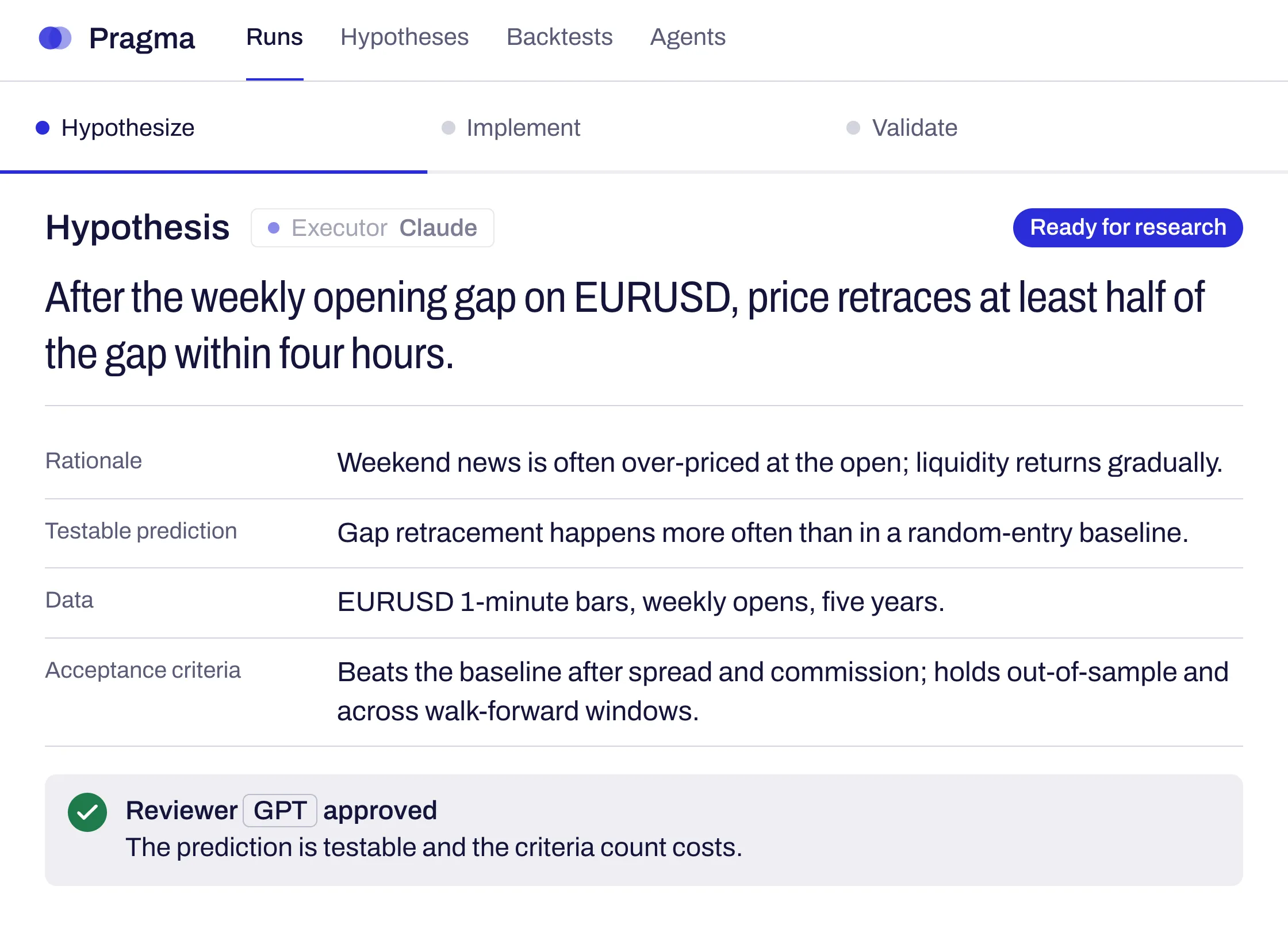
Example hypothesis
- Hypothesis
- After the weekly opening gap on EURUSD, price retraces at least half of the gap within four hours.
- Rationale
- Weekend news is often over-priced at the open; liquidity returns gradually.
- Testable prediction
- Gap retracement happens more often than in a random-entry baseline.
- Data
- EURUSD 1-minute bars, weekly opens, five years.
- Acceptance criteria
- Beats the baseline after spread and commission; holds out-of-sample and across walk-forward windows.
- Status
- Rejected— edge disappears after costs.
Research is the bottleneck
Ideas pile up, tests don't.
It can take days of work by hand to turn one idea into tested code.
Backtests flatter.
Leave out the costs and the test on data the strategy hasn't seen, and results look better than they are.
Agents without limits drift.
An AI that works on its own needs hard limits to stay useful.
From hypothesis to validated backtest
Hypothesize
Agents come up with a hypothesis that can be tested, along with the reason for it, the data it needs and the rules for passing.
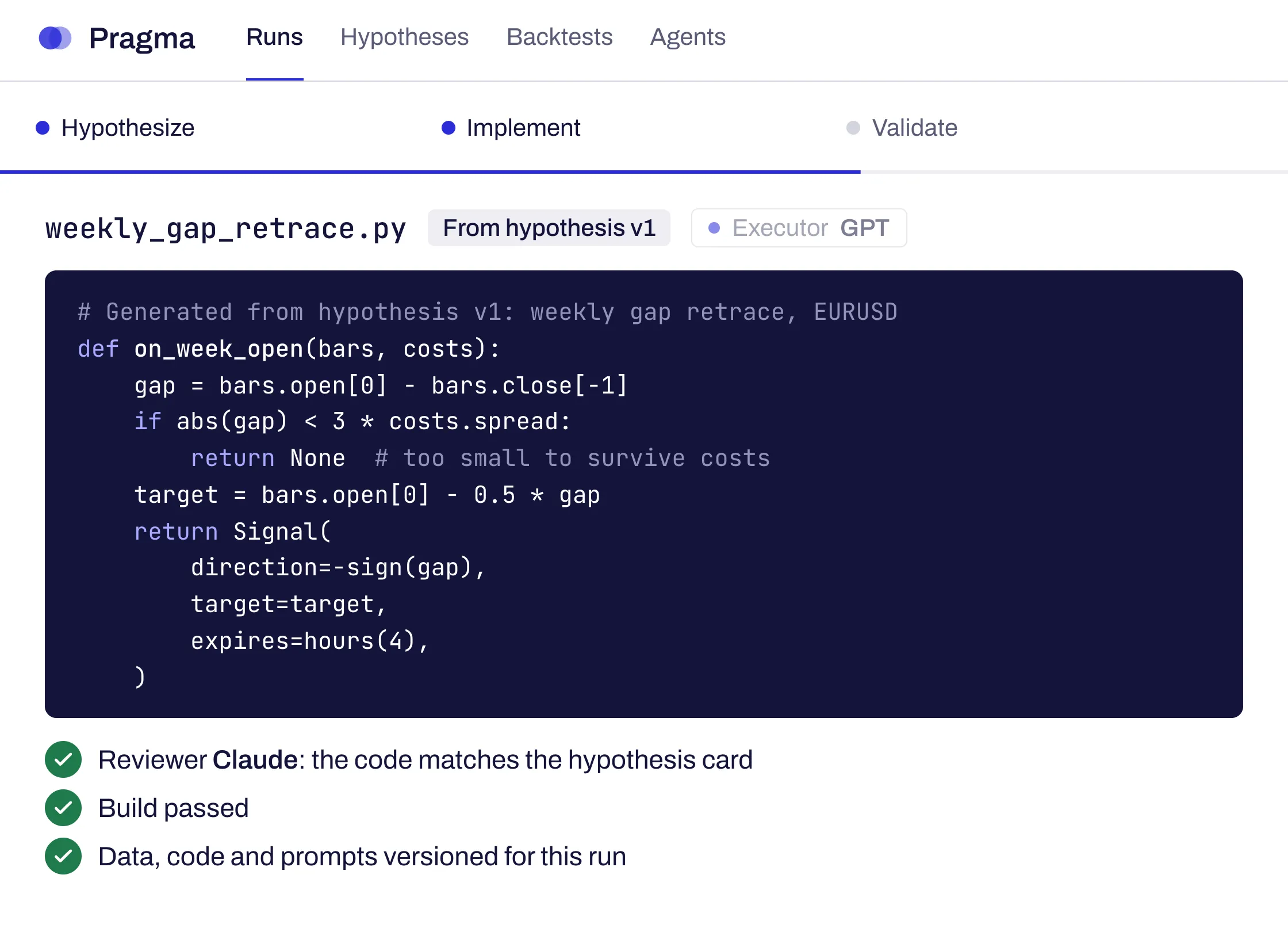
Implement
Agents turn the hypothesis into strategy code.
Validate
The strategy is backtested with costs, then checked on unseen data and in walk-forward windows.
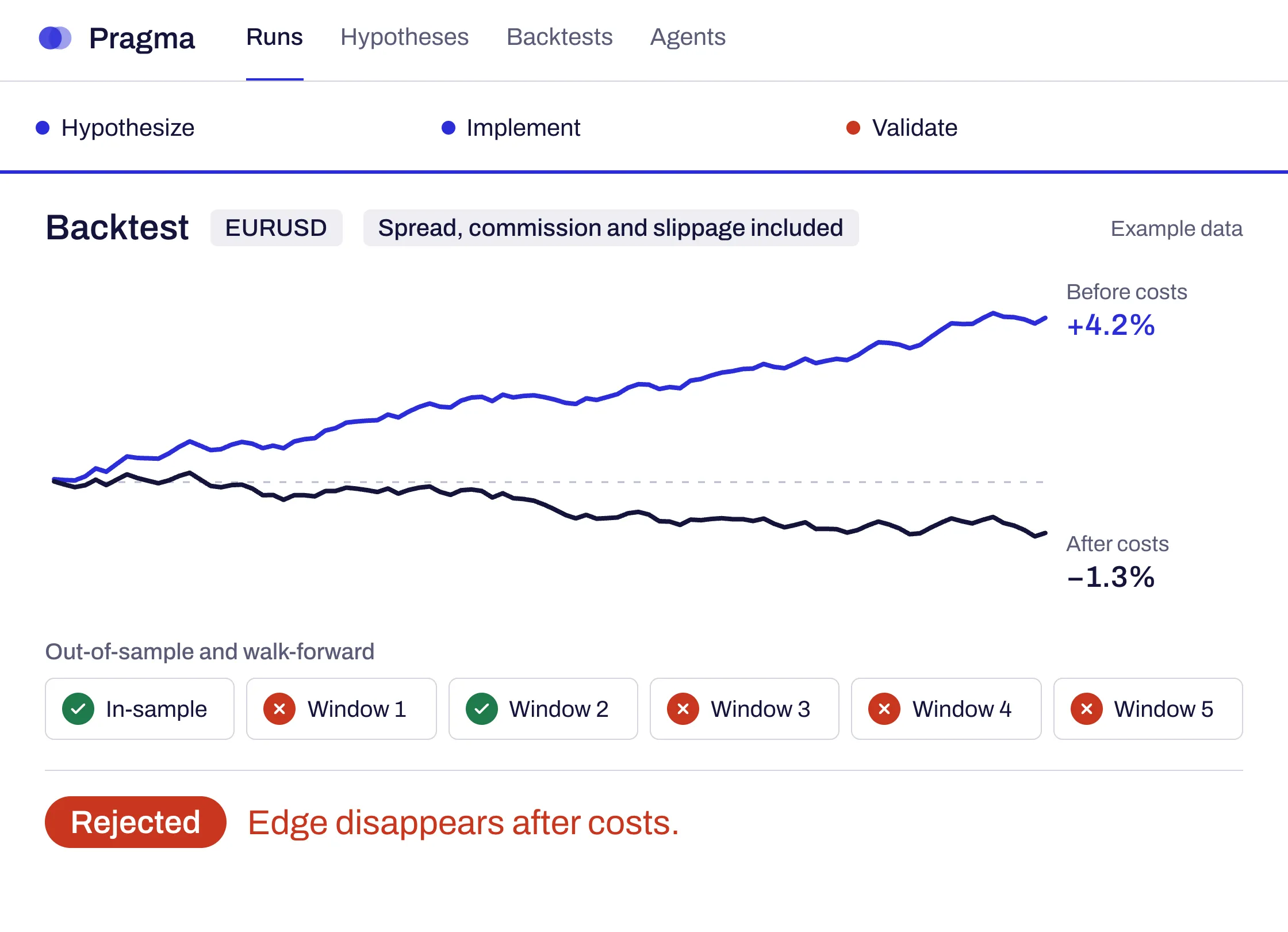
The screens are simplified and the data is an example, not a trading recommendation.
Run the whole pipeline or just one stage. Choose the model and the provider for each agent.
- from hypothesis to backtest
- ~15 min
- hypotheses per run
- 30
Watch a full run
Rigor is built in, not bolted on
Out-of-sample and walk-forward
Every hypothesis is tested on data it never saw.
Realistic costs
Spread, commission and slippage are part of every backtest.
Reproducible runs
Data, code and prompts are versioned, so any run can be repeated.
Bounded autonomy
Agents work within loop and budget limits.
Any model, any agent
Pick the model and the provider for each agent. Pragma works with Claude (Anthropic), OpenAI models and other providers. Market data comes from MetaTrader 5. Pragma never makes a trade.
Pricing
Private beta
Free for the teams we accept while Pragma is in private beta.
Research seat
After the beta, a monthly fee for each researcher who uses the pipeline.
Team
For prop desks and funds: shared agent settings and run history, billed per seat.
Model usage
Agents run on your own provider keys or subscriptions, so the provider charges you for model use directly, with nothing added by Pragma.
Who builds Pragma

Oleksii Zahumennyi
CEO
Decides what each agent does, how its work is checked and when a loop has to stop.

Serhii Orlov
CTO
Builds the system the agents use, from market data and backtests to the infrastructure behind every run.
Join the private beta
We review requests weekly and reply by email.
Request access