How Pragma works
Pragma runs research as a chain of AI agents. Each stage has its own result, and they all work inside the same guardrails.
Hypothesize
Output: a hypothesis card — the statement, its rationale, a testable prediction, the data it needs and the criteria it must meet.
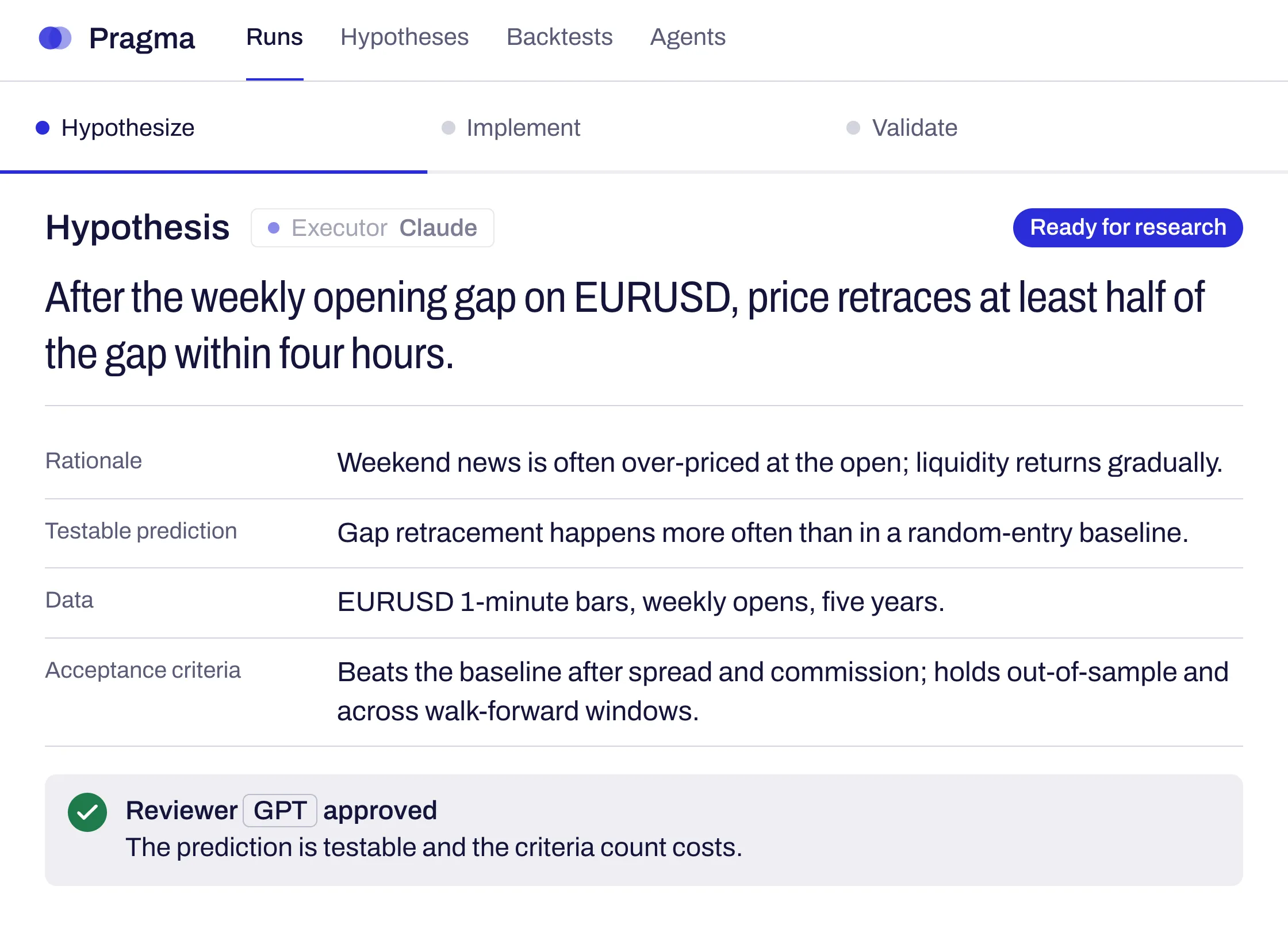
The hypothesis card after review: one agent wrote it, another approved it. Implement
Output: strategy code generated from the hypothesis card, ready for backtesting.
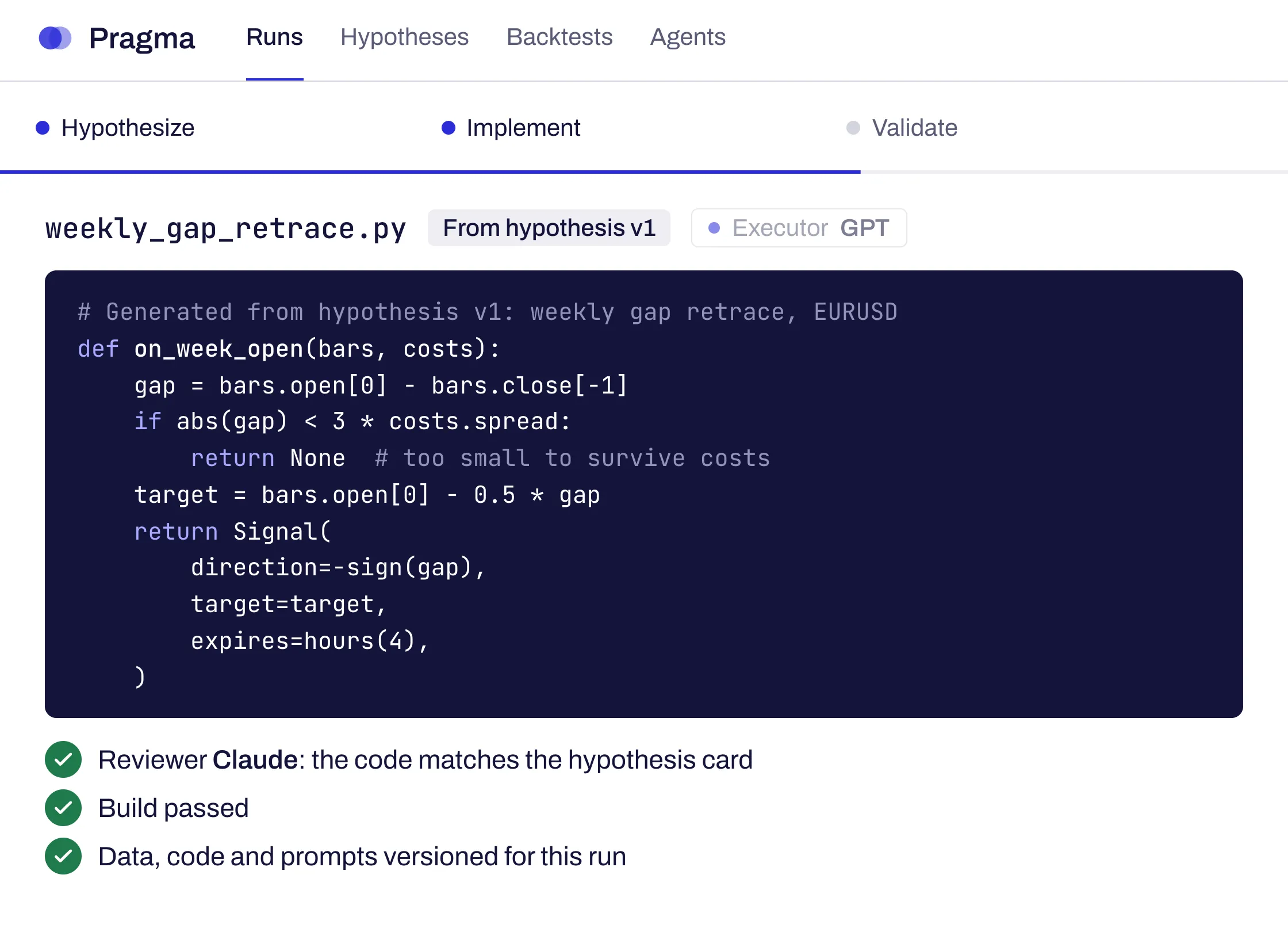
Strategy code generated from the card, checked by the reviewer and the build. Validate
Output: a backtest that includes spread, commission and slippage, out-of-sample and walk-forward checks, and a verdict: validated or rejected.
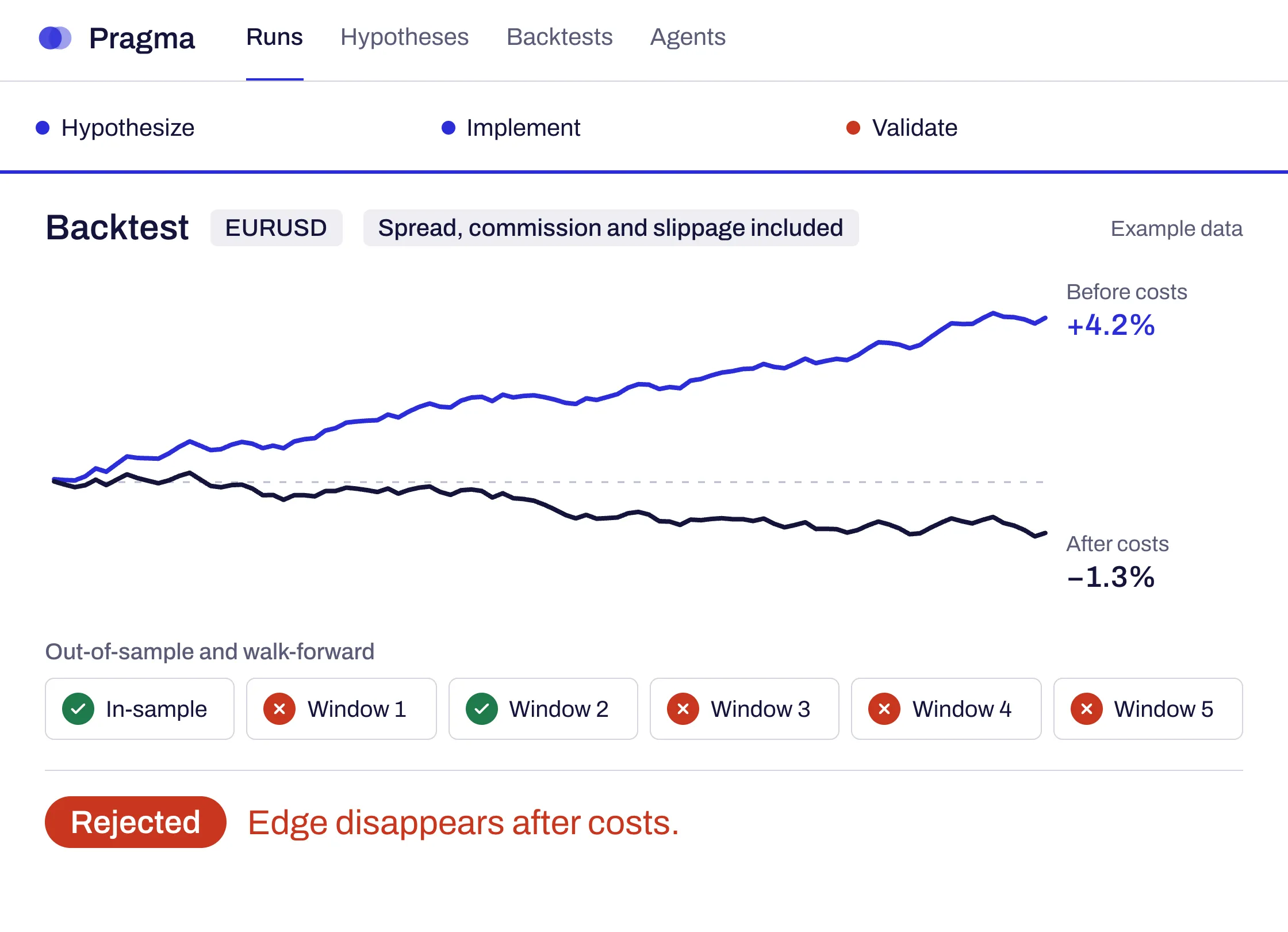
The backtest before and after costs, across walk-forward windows, ending in a verdict.
The screens are simplified and the data is an example, not a trading recommendation.
Guardrails
Out-of-sample and walk-forward
Every hypothesis is tested on data it never saw.
A strategy that only works on the data it was built on isn't a result. Pragma keeps some data aside and tests again across rolling windows before a hypothesis can pass.
Realistic costs
Spread, commission and slippage are part of every backtest.
Short-term ideas often disappear once you count the costs. Costs are in the backtest from the first run, not added at the end.
Reproducible runs
Data, code and prompts are versioned, so any run can be repeated.
Every run saves the data, code and prompts it used, so you can trace a result and run it again the same way.
Bounded autonomy
Agents work within loop and budget limits.
Agents have limits on how many times they can loop and how much they can spend. When a limit is hit, the run stops instead of going on and on.
Any model, any agent
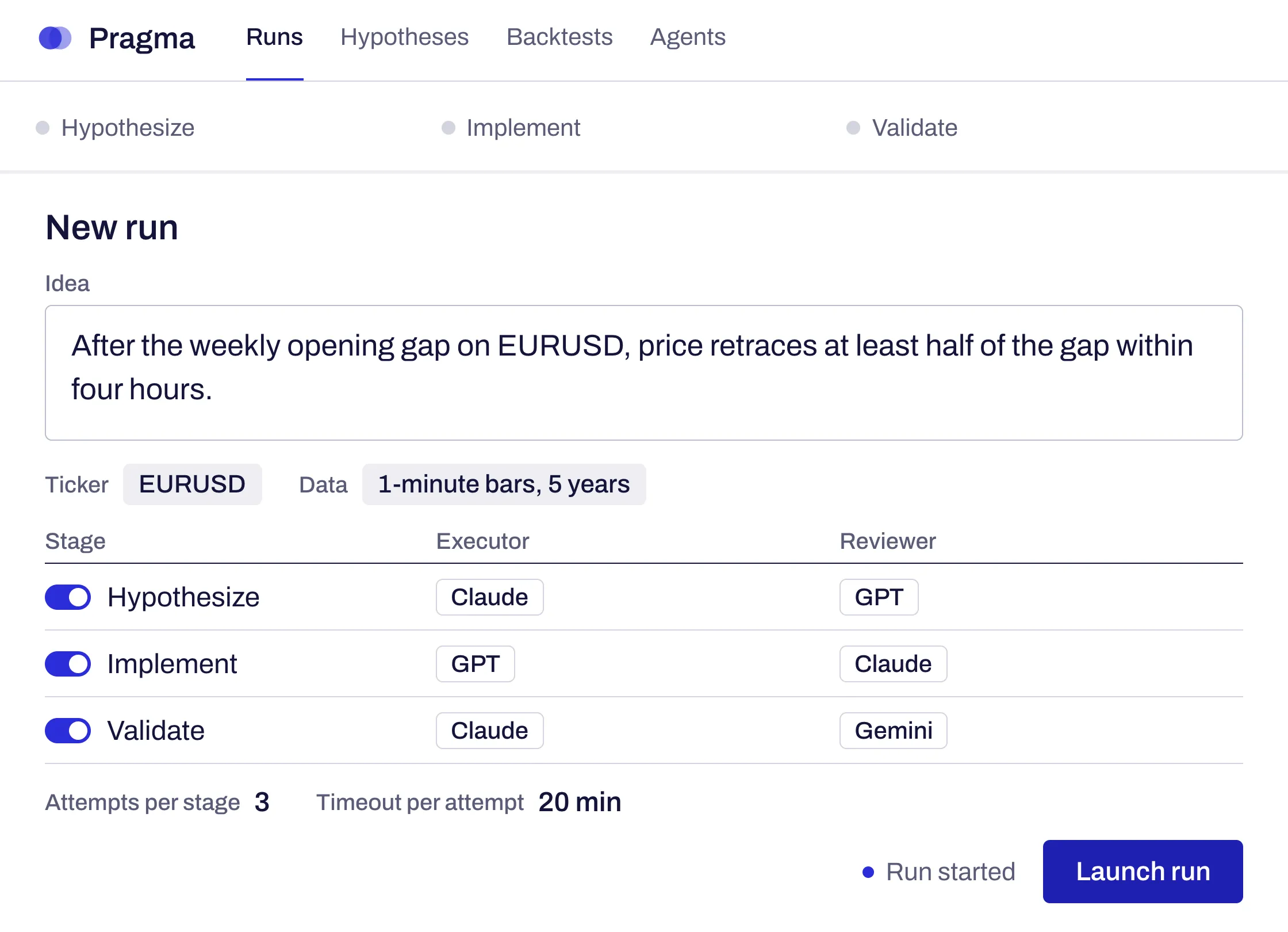
Pick the model and the provider for each agent. Pragma works with Claude (Anthropic), OpenAI models and other providers. Market data comes from MetaTrader 5. Pragma never makes a trade.
FAQ
Is Pragma a trading bot?
No. Pragma is research software. It helps you create and test trading ideas; it doesn't trade for you or tell you what to trade.
Do you provide signals?
No.
Which platforms does it work with?
Pragma uses MetaTrader 5 market data. It does not connect to a broker or place trades.
Which AI models does it use?
You pick the model and provider for each agent.
Can I run only one stage?
Yes. Each stage runs on its own or as part of the full pipeline.
Who is it for?
Prop desks, funds, quant researchers and systematic traders.
How much does it cost?
Pragma is free during the private beta. After that you pay per researcher each month, with team plans for prop desks and funds. Model use runs on your own provider keys.
Pragma is research software. It does not provide investment advice, trading signals or portfolio management. Simulated results do not guarantee future performance. Trading leveraged instruments carries a high risk of loss.